Bathroom Plumbing Services in Dothan, AL
A running toilet, dripping faucet, leaking sink connection or faulty shower valve can waste water and make a bathroom difficult to use. Call Dothan Plumbing Co. about toilet, sink, faucet, shower, bathtub and bathroom-fixture problems—from one worn component to several symptoms that may need a wider plumbing assessment.
When Should You Call About a Bathroom Plumbing Problem?
Call when a toilet keeps running, rocks at the floor, leaks near its base, flushes poorly or clogs repeatedly; when a faucet drips or will not shut off; or when a sink, shower or tub has a persistent leak, slow drain, pressure problem or temperature-control issue. One affected fixture usually suggests a local part or connection. Similar symptoms at several fixtures may involve a branch drain, water-supply line, pressure problem or water heater.
If water is actively spreading
Close the fixture shutoff—or the main water shutoff if necessary and safe—stop using the fixture and keep people away from water near electrical sources. Then call (256) 406-9676 and describe what is happening.
Start with these details
- Which fixture is affected
- When the symptom appears
- Whether water can be stopped
- Whether other fixtures are affected
- What has already been tried
- Where visible water first appears
Bathroom Plumbing Problems and Fixtures Covered
Bathroom problems may involve the fixture itself, the water supply, the drain connection or a wider plumbing condition.
Toilets
Toilets that run, leak, rock, clog, flush weakly or refill incorrectly, including toilet repair, replacement and fixture installation.
Faucets & Sinks
Dripping faucets, handle leaks, poor flow, vanities, P-traps, pop-up drains, supply lines and sink connections.
Showers & Tubs
Shower valves, cartridges, diverters, showerheads, tub spouts, bathtub drains, stoppers and overflow assemblies.
Supply Connections
Fixture shutoff valves, flexible supply connectors and leaks around accessible water-supply connections.
Flow & Temperature
Localized low water pressure, unstable shower temperature and symptoms that may involve the water heater.
Fixture Installation
Bathroom fixture installation during a planned update, with project boundaries and connection changes confirmed first.
Match the Symptom to the Right Service
These symptoms can help identify the relevant next step, but they are not a guaranteed diagnosis.
| What you notice | What it may indicate | Relevant next step |
|---|---|---|
| Toilet runs after the tank fills | Flapper, fill valve, tank-level or flush-valve problem | Toilet component assessment |
| Water appears around the toilet base | Failed seal, loose connection, flange issue, condensation or a nearby leak | Stop using the toilet and locate the source |
| Toilet rocks when used | Loose mounting, uneven support or flange problem | Toilet reset or installation assessment |
| Toilet clogs repeatedly | Trapway obstruction, branch-drain restriction or fixture problem | Toilet and drainage assessment |
| Faucet drips or leaks at a handle | Worn cartridge, stem, seal or connection | Faucet repair or replacement assessment |
| Water appears inside the vanity | Supply connector, shutoff, faucet, P-trap or drain leak | Shut off the fixture when safe and request repair |
| One sink drains slowly | Stopper, trap or local drain buildup | Local sink or drain assessment |
| Several fixtures drain slowly or gurgle | Branch-drain, venting or wider drainage issue | Drain-system assessment |
| Shower temperature is difficult to control | Cartridge, mixing valve, pressure-balancing valve or hot-water issue | Shower-valve or hot-water assessment |
| Pressure is low at one fixture | Restricted aerator or showerhead, cartridge or local valve problem | Local fixture assessment |
| Pressure is low throughout the property | Supply, pressure-regulator or wider plumbing issue | Broader plumbing assessment |

Toilet Repair and Installation
Toilet problems may begin inside the tank, at the water connection, within the trapway or where the fixture meets the floor. The location and timing of the symptom help distinguish a small component repair from a drainage or installation problem.
Running, Noisy or Weak-Flushing Toilets
A toilet that continues running or cycles by itself may have a worn flapper, incorrect float setting, failing fill valve or flush-valve seal problem. A weak flush may be related to tank water level, restricted rim passages, a partial trapway blockage or the connected drain.
Avoid repeatedly flushing a toilet that is close to overflowing. If a basic handle or flapper check does not stop the symptom, call about an assessment.
Water at the Base or a Rocking Toilet
Water near the base is not always caused by the wax ring. It can come from a tank connection, supply connector, shutoff valve, condensation or another nearby source. A toilet that moves may have loose mounting, uneven support or a damaged or incorrectly positioned closet flange.
Stop using the fixture if water returns around the base after flushing. Continued use can allow moisture to reach the flooring or the area below.
Toilet Repair or Replacement
Repair may make sense when the bowl and tank are intact and the problem is limited to an accessible, compatible component. Replacement may be considered when porcelain is cracked, problems keep returning, parts are difficult to obtain, the mounting condition requires substantial work or the owner wants a different height, bowl shape or water-use profile.
For efficiency comparisons, the U.S. Environmental Protection Agency explains how independently certified toilets, faucets and showerheads are evaluated through its WaterSense product program.
Bathroom Sink, Faucet and Vanity Plumbing
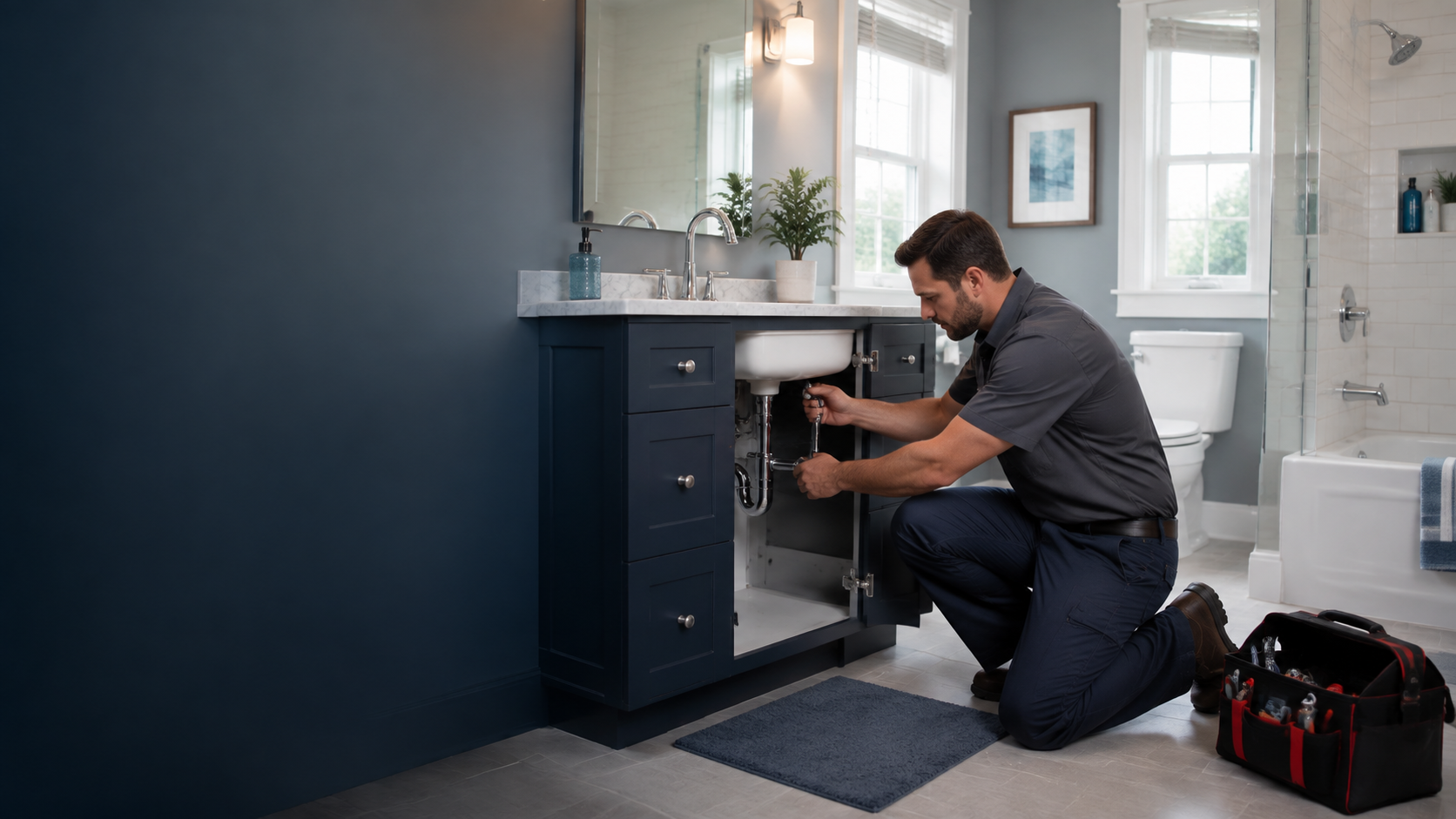
A bathroom sink combines water-supply and drainage parts in a compact cabinet area. Common failure points include the faucet cartridge, aerator, shutoff valves, supply connectors, pop-up drain, tailpiece and P-trap.
Dripping Faucets and Vanity Leaks
A steady drip may come from a worn cartridge, stem, washer or seal. Water at a handle or faucet base can travel along the countertop or supply line before appearing inside the vanity, so the visible wet spot may not be the original source.
Faucet repair may be appropriate when the body is sound and a compatible internal part is available. Replacement may be more practical when corrosion is extensive, leaks recur, parts are unavailable or the faucet does not fit the sink configuration.
Slow Sink Drains and P-Trap Problems
Hair, soap residue and debris can collect around a pop-up stopper or inside the trap. A loose slip-joint connection or failed drain seal may leak only while the basin empties. One affected sink may have a local problem; several slow or gurgling fixtures are more likely to require a wider drainage assessment.
Do not mix chemical drain products. If any product has already been used, mention it when requesting help.


Shower and Bathtub Plumbing
Shower and tub problems may involve the visible fixture, a valve inside the wall, the drain connection or the hot- and cold-water supply.
Shower Valves, Cartridges and Diverters
A cartridge or mixing valve controls water flow and temperature. A pressure-balancing or thermostatic valve manages temperature changes, while a diverter directs water between the tub spout and showerhead. Possible valve symptoms include dripping after shutoff, a difficult handle, unstable temperature or water continuing from the tub spout when the shower is selected.
Low flow at only the showerhead may be a local restriction. Low pressure at several fixtures points toward a broader supply issue. If hot-water trouble affects the entire property, the water heater is more likely to be involved than one shower control.
Tub Drains, Stoppers and Overflow Assemblies
A slow tub drain may involve buildup near the stopper or a deeper branch-drain restriction. Water below a tub or on the ceiling underneath may come from the drain flange, waste-and-overflow assembly, supply plumbing, valve or enclosure.
Plumbing work addresses pipes, valves and drain connections. Failed caulk, grout, tile, shower-pan waterproofing or wall damage may require another trade. Resealing a visible edge will not correct a leaking pipe or drain connection behind it.
Is It One Fixture or a Wider Plumbing Problem?
One Fixture
When one toilet, faucet, sink or shower is affected, a local part, seal, connection or fixture problem is more likely.
One Bathroom
When several fixtures in one bathroom drain slowly or gurgle, the bathroom branch drain or venting may need assessment.
Several Rooms
When fixtures in different rooms are slow or backing up, request drain cleaning and clogged-drain help.
Unexplained Water
When water appears without a clear fixture source, request plumbing repair and leak detection.
Property-Wide Hot Water
When hot water is poor at several fixtures, review water-heater repair and installation.
Urgent Risk
When water will not stop, sewage is backing up or water is near electricity, follow safe shutoff steps and request urgent help.
Bathroom Plumbing Repair or Fixture Replacement?
The appropriate choice depends on fixture condition, access, compatible parts, repair history and the condition of surrounding connections.
| Condition | Repair may be appropriate | Replacement may be more practical |
|---|---|---|
| Component failure | One accessible flapper, valve, cartridge, seal or connector has failed | Parts are unavailable or several components are failing |
| Fixture condition | Toilet, faucet, sink or valve body is intact | Porcelain is cracked, the body is corroded or mounting is damaged |
| Problem history | First occurrence with a clear local cause | Leaks, clogs or control problems keep returning |
| Compatibility | Existing fixture fits the connections and intended use | New dimensions or connection changes make replacement preferable |
| Project scope | A small repair restores normal operation | Layout or rough-in changes require installation work and other trades |
What Should You Do Before Help Arrives?
- Stop using a fixture that is overflowing, leaking at the floor or sending water into a cabinet, wall or ceiling.
- Close the local shutoff if it turns normally and can be reached safely. Use the main shutoff only when necessary and safe.
- Keep people and pets away from sewage or standing water near electrical outlets, lighting or appliances.
- Move belongings away from the wet area when this can be done safely.
- Note whether the problem happens during flushing, while water runs, as a fixture drains or while it is unused.
- Do not mix drain cleaners or dismantle concealed valves, electrical components or pressurized connections.
What Happens After You Request Help?
The exact scope depends on access, fixture condition and what is found during assessment.
- Describe the fixture and symptom.Explain whether one or several fixtures are affected.
- Share the history.Mention when it started, whether it returns and what has already been tried.
- Identify the likely scope.The fixture and related supply or drainage symptoms can be assessed.
- Review the next step.This may involve adjustment, repair, resealing, reconnection, drain service or replacement.
- Check operation.Relevant connections, flow, drainage and fixture operation should be checked after the work.
Bathroom Plumbing Cost and Project Boundaries
Bathroom plumbing cost depends on the affected component, problem severity, access, number of fixtures, parts, repair-versus-replacement decision and whether new connections or a wider drain assessment are needed. Work inside walls, floors, ceilings or finished cabinets can also change the scope.
Before approving work, ask what caused the problem, what is included, which parts may be repaired or replaced, whether hidden damage could be found and whether another trade or permit may be required.
For installation or layout changes, confirm the complete project scope before demolition. The City of Dothan provides official plumbing permit requirements and project-specific contact information through its Permits & Inspections office.
Confirm what the project includes
Bathroom plumbing may include fixture removal and installation, water-supply connections, shutoff valves, drain connections, traps, valve components and testing.
It may not include cabinetry, countertops, framing, drywall, tile, shower-pan waterproofing, flooring, painting, electrical work, ventilation work or remediation of existing damage.
Related Plumbing Services
Use the symptom and number of affected fixtures to choose the most relevant service page.
Frequently Asked Questions About Bathroom Plumbing
Who should I call for a clogged bathroom sink or drain in Dothan?
A clog limited to one bathroom sink may be near the stopper or P-trap. A recurring clog, gurgling or several slow fixtures is more likely to need drain cleaning and clogged-drain service. Avoid mixing chemical drain products, and mention anything already used.
Why does my toilet keep running after it fills?
Possible causes include a worn flapper, incorrect float setting, failing fill valve or flush-valve seal problem. Because several parts can cause the same symptom, the fixture may need assessment before choosing a replacement component.
Is water around the toilet always a failed wax ring?
No. Water near the base can come from the toilet seal, supply connector, shutoff valve, tank connection, condensation or a nearby fixture. Stop using the toilet if water returns after flushing.
Why is my shower pressure low but the sink pressure is normal?
When only the shower is affected, a restricted showerhead, cartridge or local valve is more likely. Low pressure at several fixtures points toward a broader supply or pressure issue.
Why does my shower go hot and cold?
Possible causes include a worn cartridge, mixing or pressure-balancing valve problem, changing household demand or a hot-water supply issue. If the problem affects multiple fixtures, begin with water-heater service.
Should I repair or replace a leaking bathroom faucet?
Repair may make sense when the faucet body is sound and the correct cartridge, stem or seal is available. Replacement may be more practical when corrosion is extensive, leaks recur, parts are unavailable or a different configuration is needed.
When is a bathroom plumbing problem urgent?
Treat the problem as urgent when water will not stop, a toilet is overflowing, sewage is entering the room, water is spreading into walls or ceilings, or standing water is near electricity. Stop using the fixture, shut off water when safe and request emergency plumbing help.
Request Bathroom Plumbing Help in Dothan
Describe the affected fixture, when the problem occurs and whether another fixture or room has the same symptom. That information helps distinguish a local component problem from a wider drain, supply, leak or hot-water issue.